Electronic Signature Evidence: What It Establishes
Records supporting review of who signed, their intended action, the document version and the integrity of the signing record.


- Evidence connects a signing action to a person, document version and context.
- Audit events and cryptography support review without making disputes impossible.
- Admissibility and how persuasive the evidence is remain distinct questions.
What is electronic signature evidence?
Electronic signature evidence is the information used to assess a signing act and its connection to a particular person and document. The visible signature is one element; it is not the entire evidence record.
What questions should the evidence answer?
- Attribution: which person, account or access channel was associated with the action, and how was it checked?
- Intent: what deliberate action was taken, and what document or statement did it concern?
- Timing and sequence: which events were recorded and in what order?
- Integrity: is the retained version consistent with the signed content, and what changes occurred?
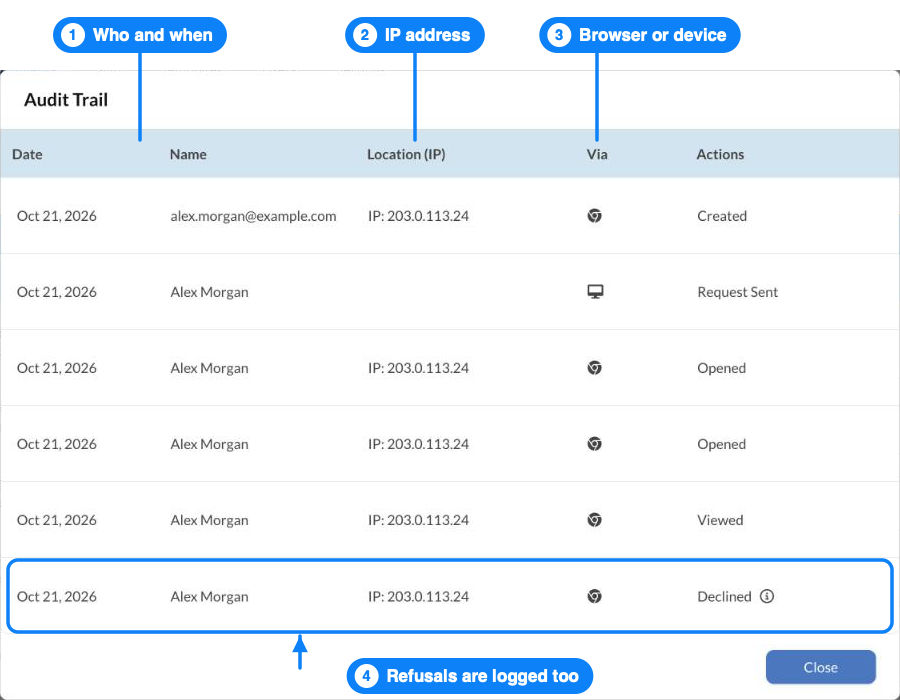
An audit history, authentication results and certificate of completion can contribute to these questions. Their meanings depend on the actual workflow. A shared mailbox, mistaken recipient or authority dispute may require other evidence; a timestamp or IP address does not settle those issues alone.
What does non-repudiation mean?
Non-repudiation means providing evidence that helps establish who took an action if that person later denies it. It does not make denial impossible or guarantee that a court will accept every recorded claim. Cryptographic mechanisms can support attribution and integrity, but the surrounding identity, process and preservation evidence still matters.
A hash chain links records through successive hashes and can help reveal changes when supported by a trusted reference and process. The term is not proof that a platform uses one, nor a substitute for reviewing how evidence was produced.
Admissibility versus evidentiary weight
In US federal proceedings, Federal Rule of Evidence 901 addresses support for a finding that an item is what its proponent claims. Rules 902(13) and (14) provide particular certification routes for some electronic records or copied data. A generic completion report does not automatically satisfy those routes or remove every other admissibility question.
Delivery or access records must be read for the events they establish. The electronic-signature verification guide covers practical checks; preserve the original file and associated evidence for that review.
A Common Case: Retaining a provider note’s signing history
A Nevada behavioral-care administrator might retain a signed provider note with its associated signing history under the organization’s authorized recordkeeping process. If the record is later questioned, the review would consider the note, attribution and event meanings together, without assuming a timestamp resolves every issue.
FAQs
Does an audit trail conclusively prove who signed?

No. It records events and metadata from the process; identity, access, intent and surrounding evidence still need appropriate interpretation.
Does non-repudiation mean a signature can never be challenged?
No. It describes evidentiary or technical support against denial, not a guarantee that disputes are impossible or every legal requirement is satisfied.

Featured Articles
See All





Confédération Suisse
Confederazione Svizzera
Confederaziun Svizra
Швейцарская Конфедерация
Innosuisse — Швейцарское агентство по содействию инновациям