


Skribble Review 2026: Pricing, QES, and the Best Skribble Alternatives
Skribble bundles SES, AES and QES for DACH teams, but its quotas expire, QES needs a paid identification and the data center is fixed for the whole contract. We compared every plan, QES costs, data location, compliance, the API and the contract terms, sent a test agreement, and ranked the best Skribble alternatives for 2026.


- Skribble Team costs €23 or CHF 23 per user per month and Pro €36 or CHF 36 on annual billing, excluding VAT; Starter charges per signature.
- Annual Team and Pro plans include a pooled 72 or 120 AES/QES per user per year; every signer counts separately and unused signatures expire.
- QES signers pay a one-time identification fee of €22.50 or CHF 22.50, and SSO and company branding are paid Pro add-ons.
- The Swiss or German data center is fixed for the whole customer contract, and our test offered signature fields only.
- Sign.Plus is our winner: unlimited signature requests, in-person signing and public forms on Professional at $19.99, QES on every plan and up to 43 storage locations.
Sign.Plus is our top Skribble alternative for teams that want unlimited signature requests, in-person signing and public forms on Professional, plus qualified signatures on every plan and published prices for SSO, branding, API access and verification. Skribble is a practical choice for DACH teams that want SES, AES and QES in one platform with Swiss or German storage. Its subscription, signature allowances, QES identification and paid add-ons need to be compared together.
Is Skribble Worth It in 2026?
Skribble is worth considering if your organization works mainly in Switzerland, Germany or the wider European market and needs simple, advanced and qualified electronic signatures. It supports English, German, French and Italian, lets external recipients sign without a Skribble account and offers a choice of Swiss or German data centers.
The pricing model needs a closer read. Team and Pro bundle an annual pool of AES and QES signatures when billed annually, while Starter charges for every signature. A qualified signer may also need a one-time identification costing €22.50 or CHF 22.50 excluding VAT, valid for up to five years. API access starts on Pro, and SSO and company branding carry separately published annual fees.
Sign.Plus has the lower published base subscription price for a comparable team plan: Professional costs $19.99 per user per month on annual billing, compared with €23 or CHF 23 for Skribble Team. That does not automatically mean a lower total cost because Skribble Team bundles AES and QES volume. The better value depends on your signature standards, signer identities, team size and usage.
Skribble Pros and Cons
Pros
- SES, AES and QES are available in one platform.
- External recipients can sign without creating a Skribble account.
- Team and Pro include pooled AES and QES volume on annual plans.
- Customers can choose a Swiss or German data center at setup.
- A pay-per-signature Starter plan is listed on the current pricing page.
Cons
- The selected data center cannot be changed while the customer contract runs, including renewals.
- QES identification costs €22.50 or CHF 22.50 excluding VAT on Starter, Team and Pro.
- API access starts on Pro, with no separate published API price list.
- SSO and company branding add substantial setup or annual fees on Pro.
- Skribble's public materials describe browser-based mobile signing and do not list a first-party signing app.
What Is Skribble?
Skribble is an electronic signature platform operated by Skribble AG in Zurich, Switzerland, with Skribble Deutschland GmbH in Karlsruhe, Germany. It is aimed primarily at the DACH and European markets and is available in English, German, French and Italian.
The product supports all three electronic signature levels used in Europe:
- SES, or simple electronic signature: used for everyday agreements where a basic electronic signing process is sufficient.
- AES, or advanced electronic signature: adds stronger identification and document-integrity requirements.
- QES, or qualified electronic signature: uses a qualified certificate after identity verification and has the same legal effect as a handwritten signature under eIDAS in the EU.
Skribble offers four plan levels. Starter is a single-user, pay-per-signature option. Team and Pro are subscriptions for organizations, and Scale is a custom plan for higher-volume or more complex deployments.
Which Skribble Plan Is Which?
| Name you see | What it is | Published price |
|---|---|---|
| Starter | Pay-per-signature plan for one user | From €0 or CHF 0, then €1 or CHF 1 per SES |
| Team | Team plan with unlimited SES and pooled AES/QES volume | €23 or CHF 23 per user per month annually; €29 or CHF 29 monthly |
| Pro | Higher-volume plan with API access and optional enterprise features | €36 or CHF 36 per user per month annually; €49 or CHF 49 monthly |
| Scale | Custom plan for larger or higher-volume deployments | Contact sales |
How We Compared These Services
E-signature is what we work on every day. We build and run Sign.Plus for everyone from freelancers and small offices to healthcare providers, law firms and international companies, and we follow the questions teams ask when they compare tools or move away from one.
For this guide we read Skribble's pricing page and pricing FAQ, its plan comparison, identification and Express QES materials, security information, data-location terms and general terms and conditions. We also rechecked every price on the vendors' own pages in November 2026. Where a capability is marked as not published or not listed, Skribble does not state it in the public materials reviewed. That makes it a question to confirm with Skribble, not proof that the capability is unavailable.
We also tested Skribble hands-on. We sent a test agreement for a simple electronic signature and reviewed it from the signer's side.
1. Skribble Pricing: Every Plan
Skribble publishes the same numerical prices in euros and Swiss francs, excluding VAT. On annual billing, Team costs €23 or CHF 23 per user per month, or €276 or CHF 276 a year. Pro costs €36 or CHF 36 per user per month, or €432 or CHF 432 a year. Monthly billing costs €29 or CHF 29 for Team and €49 or CHF 49 for Pro.
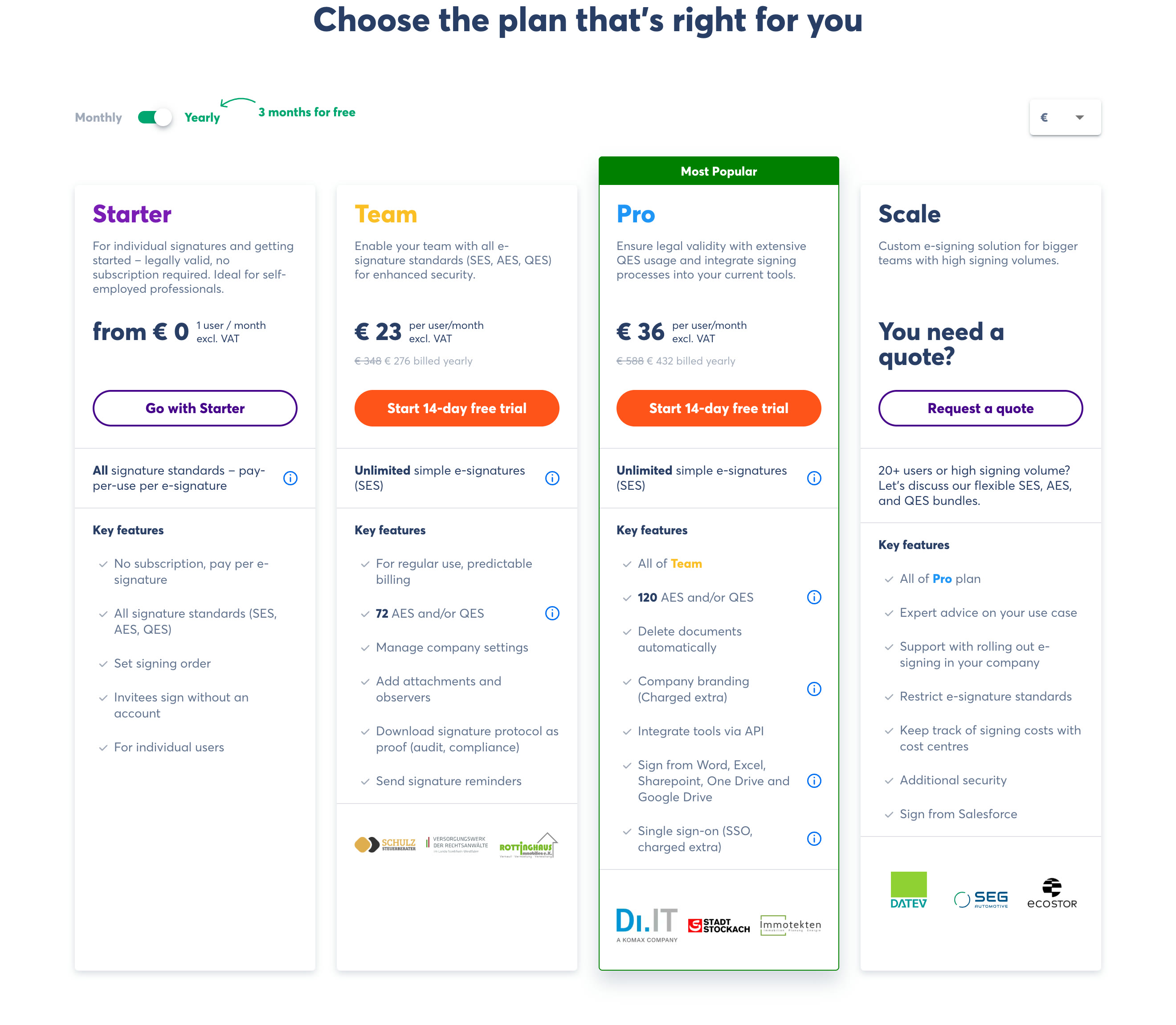
Starter is listed as a pay-per-signature plan with no subscription fee. There is an important source conflict: Skribble's current pricing page and German FAQ offer Starter as pay per signature, while its English FAQ still says there is no pay-as-you-go version and that one is planned for 2026. Because the live pricing page lists Starter now, this review treats Starter as the current offer while disclosing the contradiction.
How to Read Skribble's Plans
Five details determine the actual cost:
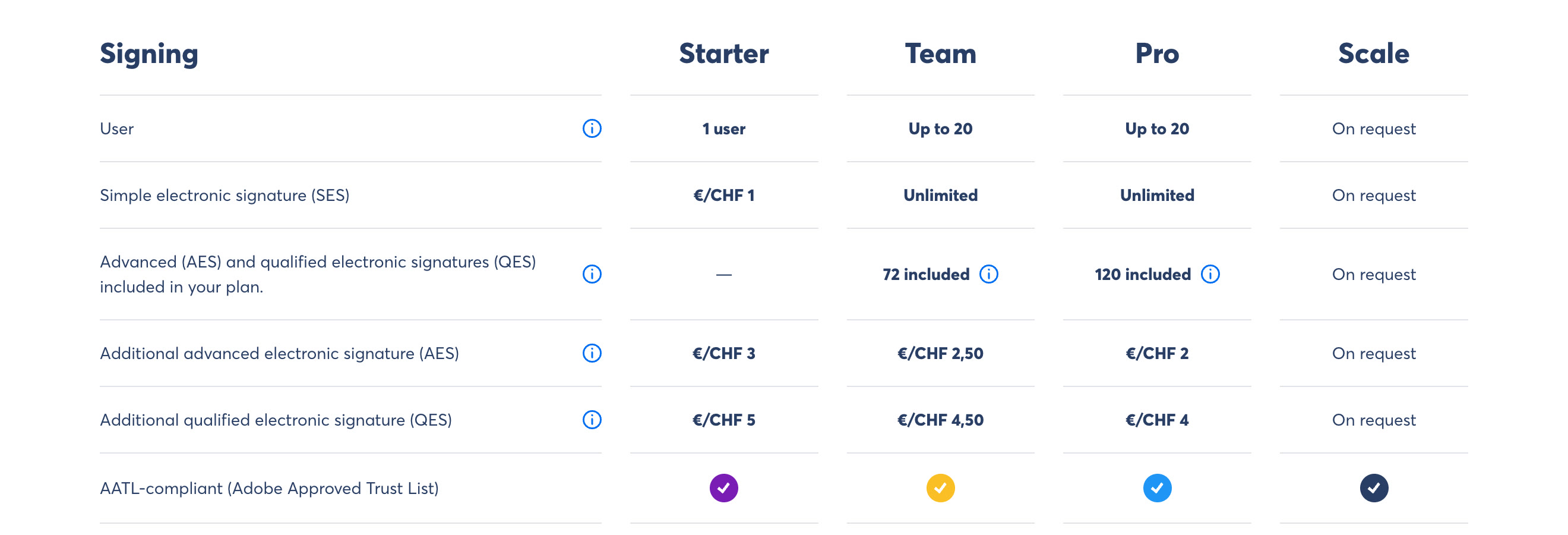
- Signature standards are billed differently. Starter charges €1 or CHF 1 per SES, €3 or CHF 3 per AES and €5 or CHF 5 per QES.
- Annual Team and Pro plans bundle AES and QES volume. Team includes 72 AES or QES signatures per user per year, while Pro includes 120. The allowances are pooled at the company level.
- Monthly allowances expire monthly. On monthly plans, the quota applies to that month and unused signatures expire at month-end. On annual plans, unused signatures expire at the end of the plan term. Every signer counts separately, so a document signed by five people uses five signatures from the pool. The annual 72 and 120 figures should not be read as monthly-plan allowances.
- The inviting party pays. External signers do not need a Skribble account, and the sender pays for the completed signature at every signature standard.
- QES identification is separate. Identity verification costs €22.50 or CHF 22.50 excluding VAT on Starter, Team and Pro. The verification is valid for up to five years.
Skribble Plans
| Plan | Annual, per user per month | Monthly | Included signatures | Highlights |
|---|---|---|---|---|
| Starter | €0 or CHF 0 | €0 or CHF 0 | None; SES €1/CHF 1, AES €3/CHF 3, QES €5/CHF 5 | One user, pay per signature |
| Team | €23 or CHF 23 | €29 or CHF 29 | Unlimited SES; annual plans include 72 pooled AES/QES per user per year | Observers, attachments, reminders and email delivery of signed files and signature protocols |
| Pro | €36 or CHF 36 | €49 or CHF 49 | Unlimited SES; annual plans include 120 pooled AES/QES per user per year | API, automatic deletion and integrations with Microsoft and Google tools |
| Scale | Contact sales | Contact sales | By quote | Cost centers, signature-standard restrictions, Salesforce and rollout support |
After the included annual pool is used, Team charges €2.50 or CHF 2.50 per AES and €4.50 or CHF 4.50 per QES. Pro charges €2 or CHF 2 per AES and €4 or CHF 4 per QES. The one-time QES identification fee of €22.50 or CHF 22.50 excluding VAT still applies to the signer identity.
Is Skribble Free?
Partly. The current pricing page lists Starter from €0 or CHF 0, but it is not a free monthly signature allowance. Each SES costs €1 or CHF 1, each AES costs €3 or CHF 3 and each QES costs €5 or CHF 5, plus the one-time €22.50 or CHF 22.50 QES identification fee when identification is needed.
Team and Pro offer a 14-day trial without a credit card. Skribble's FAQ says the trial does not automatically convert to a paid plan.
How Skribble Pricing Compares
| Platform | Team plan, annual billing | Sending model |
|---|---|---|
| Sign.Plus | Professional: $19.99 per user per month | Unlimited signature requests |
| Skribble | Team: €23 or CHF 23 per user per month | Unlimited SES; 72 pooled AES/QES per user per year on the annual plan |
| DocuSign | Standard: $25 per user per month | 100 envelopes per user per year |
| PandaDoc | Starter: $19 per seat per month | Unlimited e-signatures in the app |
| Dropbox Sign | Standard: $25 per user per month, 2-user minimum | Unlimited on paid plans |
| SignNow | Starter: $8 per account per month | 100 invites per account per year |
Prices use each vendor's published currency and are not converted. Sign.Plus Professional has the lower published base subscription price, but Skribble Team bundles annual AES and QES volume. Compare total cost using the number of users, signature standards and qualified signer identities you expect during the year.
2. What Lower Skribble Plans Leave Out
Skribble's plan comparison separates several workflow and administration features by plan:
- Starter: does not list observers, attachments, reminders or email delivery of signed documents and signature protocols to every recipient.
- Team: adds those collaboration and delivery features, along with unlimited SES and an AES/QES allowance.
- Pro: adds API access, automatic document deletion, signing through Word, Excel, SharePoint, OneDrive and Google Drive, plus optional company branding and SSO.
- Scale: adds cost centers, controls over permitted signature standards, Salesforce and rollout support.
Skribble recommends Scale above 20 users, but its own sources disagree on the limit: the plan comparison says up to 20 users, the pricing FAQ says up to 50 (20 recommended) and the terms say the number of seats is unlimited. One Business Account uses one uniform plan, so mixing Team and Pro requires separately managed and billed accounts.
Skribble's FAQ also says reusable web templates with fixed field positions are not yet available. Its plan comparison does not list in-person signing, public forms or delivery through SMS or WhatsApp. Confirm those workflows directly if they are part of your requirements.
How Skribble's Plans Compare
Sign.Plus Professional, at $19.99 per user per month on annual billing, includes unlimited signature requests, 10 templates, in-person signing, public forms and attachment requests. Passcode verification is included, while SMS code verification is available and ID Check costs $2 per check. Each Professional seat also includes a monthly allowance of 10 requests delivered by SMS or WhatsApp.
Bulk send, custom branding and Zapier start on Sign.Plus Business at $29.99 per user per month on annual billing. Skribble lists company branding on Pro for an additional €1,400 or CHF 1,400 per year.
3. Skribble QES and eIDAS Compliance
Skribble supports SES, AES and QES. For QES, the identity-verification route depends on the jurisdiction and workflow. Published options include EU video identification, an EU mobile-app route through Nect, a Swiss video call, Swiss self-identification, partner locations and existing electronic identities. An ID scan with a smartphone and a selfie video is one route, not the universal process.
Express QES is a separate workflow designed for cases such as insurance and leasing. Skribble describes an in-browser flow in which contracting partners can sign without an account or app. That description should not be applied to every standard QES workflow.
The Swiss e-ID, swiyu, was not yet available for Skribble QES identification when these materials were checked. Skribble said the federal rollout was planned for 2026.
How Skribble QES Access Compares
| Platform | Qualified signature cost | Identification cost |
|---|---|---|
| Sign.Plus | $5 per recipient on every plan, including Free | Included in the $5 per-recipient charge |
| Skribble Starter | €5 or CHF 5 per QES | €22.50 or CHF 22.50 excluding VAT once per signer identity, valid up to 5 years |
| Skribble Team | Annual plan includes a pooled AES/QES allowance; extra QES costs €4.50 or CHF 4.50 | €22.50 or CHF 22.50 excluding VAT once per signer identity, valid up to 5 years |
| Skribble Pro | Annual plan includes a pooled AES/QES allowance; extra QES costs €4 or CHF 4 | €22.50 or CHF 22.50 excluding VAT once per signer identity, valid up to 5 years |
The units are different. Skribble charges the €22.50 or CHF 22.50 identification fee once for a signer identity and says that identification remains valid for up to five years. Sign.Plus charges $5 each time a recipient uses QES. Skribble's fee spreads over later signatures by the same identified signer, while each new signer pays it again. Sign.Plus is easier to forecast for occasional or changing recipients because identity verification is part of the published per-recipient price.
Sign.Plus supports QES under eIDAS and Swiss ZertES through Swisscom Trust Services on every plan, including Free. QES uses separately purchased credits, and purchased credits do not expire. Read more about eIDAS signatures and ZertES signatures.
4. Where Your Documents Live
Skribble operates two independent data-center options, one in Switzerland and one in Germany. Customers choose a location at setup, including for API access.
The choice is fixed for as long as the customer contract runs, not just the current billing term. Skribble's terms say the location cannot be changed during that term and do not provide a refund, credit or migration for selecting the wrong one. That makes the setup decision especially important if your clients, regulator or procurement team may change their residency requirements later.
How Skribble Data Residency Compares
| Platform | Company based in | Storage choice | Can documents move later? |
|---|---|---|---|
| Sign.Plus | Geneva, Switzerland | Switzerland by default; 43 locations on Enterprise | Yes |
| Skribble | Zurich, Switzerland, with a German company in Karlsruhe | Switzerland or Germany, selected at setup | Not while the customer contract runs |
| DocuSign | United States | Five regions on Enhanced | No, the region is set when the account is created |
| PandaDoc | United States | US or EU on Enterprise | No |
| Dropbox Sign | United States | US, Australia, EU, Japan, Canada or UK on Premium | Not published |
| SignNow | United States | US or EU on Professional and higher plans | Not published |
Sign.Plus stores documents in Switzerland by default. Enterprise customers can select from 43 locations across the Americas, Europe, Asia Pacific, the Middle East and Africa, including Geneva, Zurich, Frankfurt, Paris, Madrid, Milan and Warsaw. Documents can move later if business or regulatory requirements change. See the Sign.Plus guide to what data residency means for e-signatures.
Looking for a European Alternative?
Both Skribble and Sign.Plus are Swiss providers, so this is not a choice between a European and a non-European company. The practical difference is storage flexibility. Skribble offers Switzerland or Germany and fixes the choice for as long as the customer contract runs. Sign.Plus uses Swiss storage by default and gives Enterprise customers 43 location choices, with the ability to move documents later.
Sign.Plus is built by Alohi, headquartered in Geneva. Alohi is dedicated to protecting personal data and upholds the standards set by the GDPR, and qualified signatures under EU eIDAS and Swiss ZertES are available on every plan through Swisscom Trust Services.
5. Skribble Security and Compliance
Skribble states that its system architecture is ISO 27001 certified and that it uses AES-256 encryption. Its public materials also state compliance with the Swiss Data Protection Act and GDPR. Skribble lists AATL support and describes its signatures in the context of eIDAS, ZertES, UETA and ESIGN.
SOC 2 is not published in the Skribble materials reviewed. HIPAA support and a Business Associate Agreement are also not published. These are questions to confirm directly if your procurement or healthcare workflow requires them.
How Skribble Compliance Compares
| Platform | HIPAA and BAA | ISO 27001 | SOC 2 Type 2 |
|---|---|---|---|
| Sign.Plus | Enterprise with Advanced Security Controls and a signed BAA | Certified to ISO/IEC 27001:2022 by EY CertifyPoint | Report from EY |
| Skribble | Not published | System architecture listed as certified on its site | Not published |
| DocuSign | BAA available; listed on Enhanced | Yes | Yes |
| Dropbox Sign | Annual Standard or Premium with a BAA and unpublished minimum contract value | Yes | Yes |
| SignNow | Enterprise paid add-on; price not published | Yes | Yes |
Sign.Plus has ISO/IEC 27001:2022 certification from EY CertifyPoint, a SOC 2 Type 2 report from EY and a listing on the CSA STAR Registry. HIPAA support requires Sign.Plus Enterprise with Advanced Security Controls and a signed BAA, at a published $49.99 per user per month on annual billing.
6. Signing Experience and Where Sign.Plus Does More
Skribble lets external recipients sign without creating an account, and the inviting party pays for the requested signature standard. Its public materials describe signing on phones through the browser and do not list a first-party signing app. For one EU QES route, identification runs through the third-party Nect app. Other identification paths use different processes.
Skribble's plan comparison does not list in-person signing, public forms or delivery through SMS or WhatsApp. Sign.Plus Professional includes in-person signing and public forms, while every paid seat includes a monthly allowance for requests delivered by SMS or WhatsApp.
What We Saw When Sending a Test Document
Choosing the Signature Level
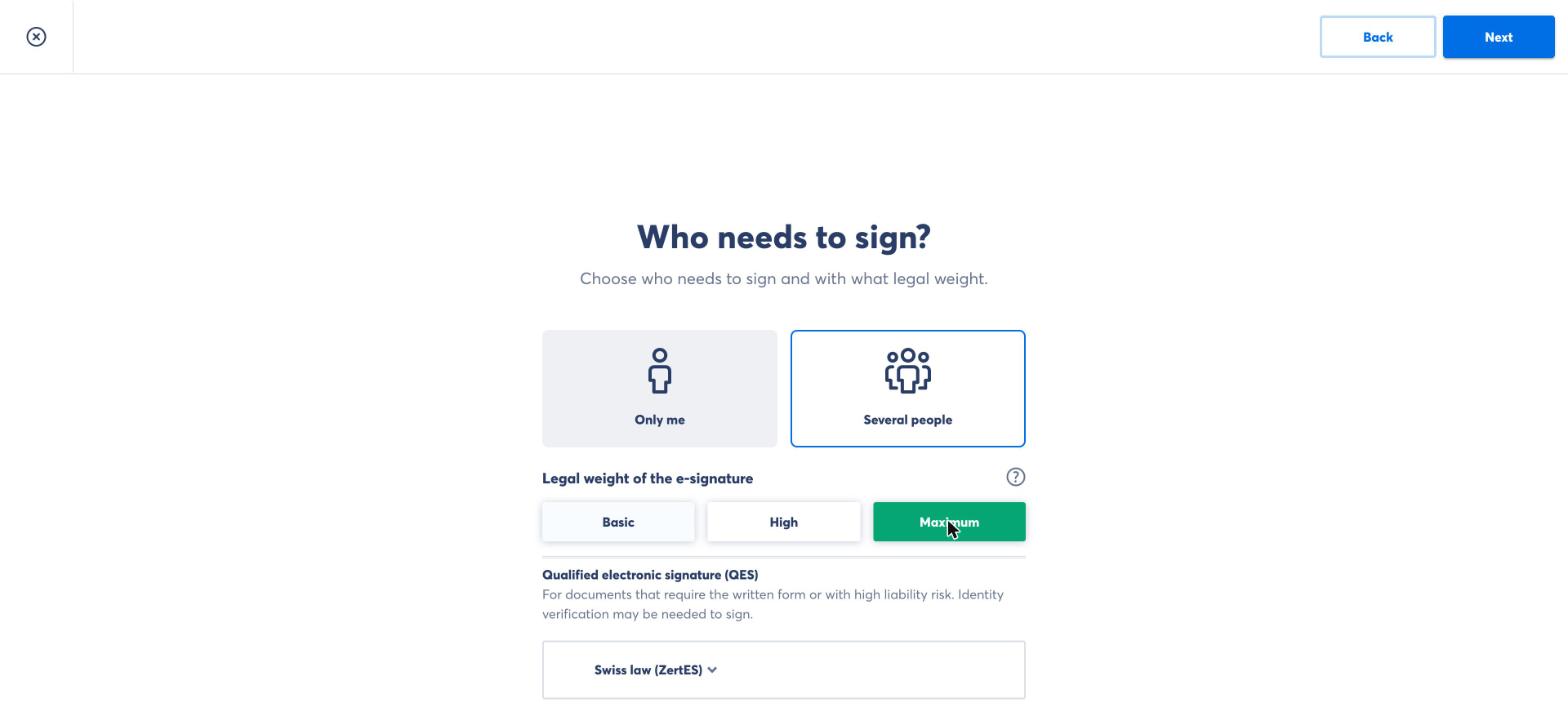
A new request starts with the document upload, then asks who signs and with what legal weight: Basic (SES), High (AES) or Maximum (QES). For QES, the sender picks Swiss law (ZertES) or EU law, and Skribble warns that identity verification may be needed before the recipient can sign. Choosing the standard up front is clear, and it also decides what the request costs from your quota.
Placing Signatures
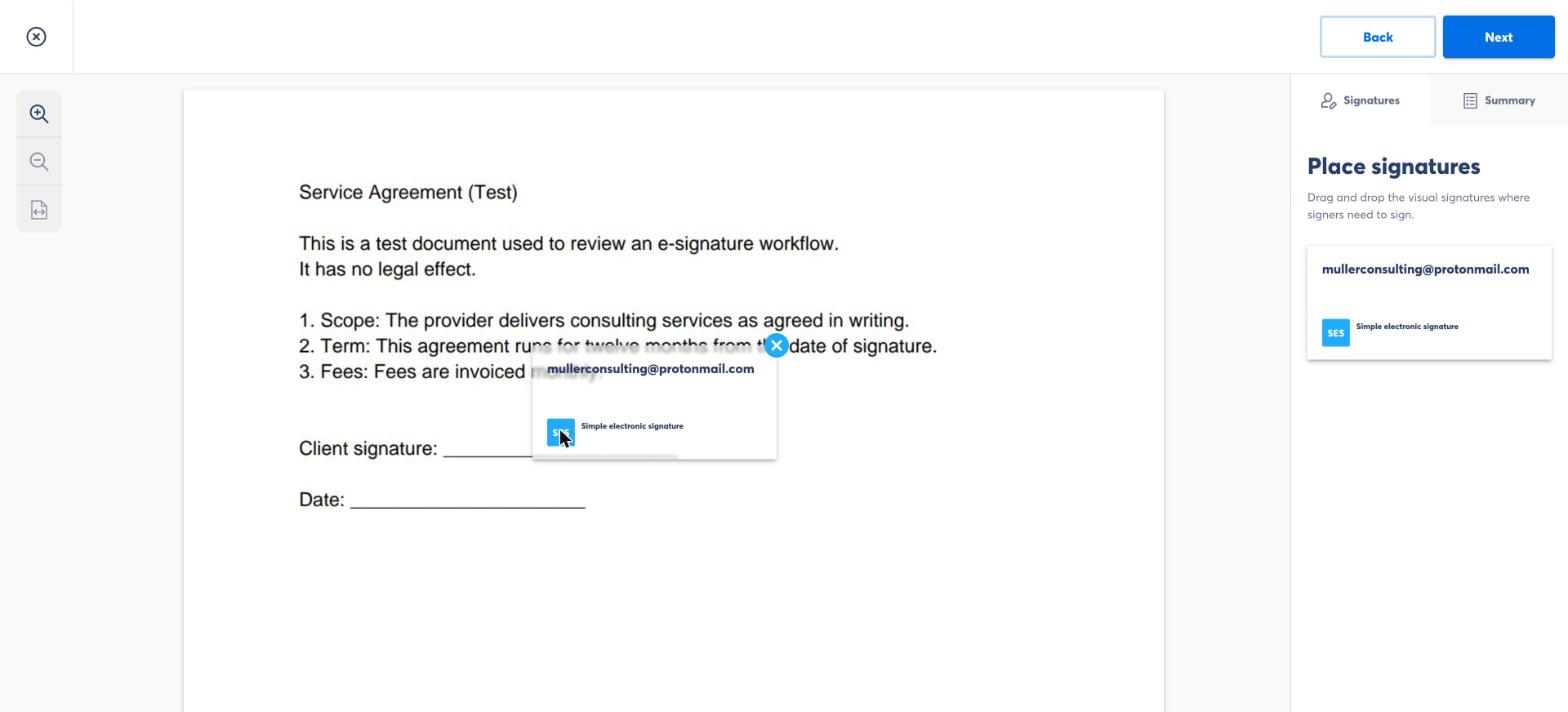
After adding the signer by email, you drag a visual signature for each signer onto the page. In our test, this step offered signature placement only, with no separate date, text, initials or checkbox field. Our test document had a "Date" line that we could not assign to the signer. Skribble shows the signing date inside the signature stamp instead. Skribble's FAQ also says the web platform cannot yet save templates with fixed signature positions.
Sending the Request
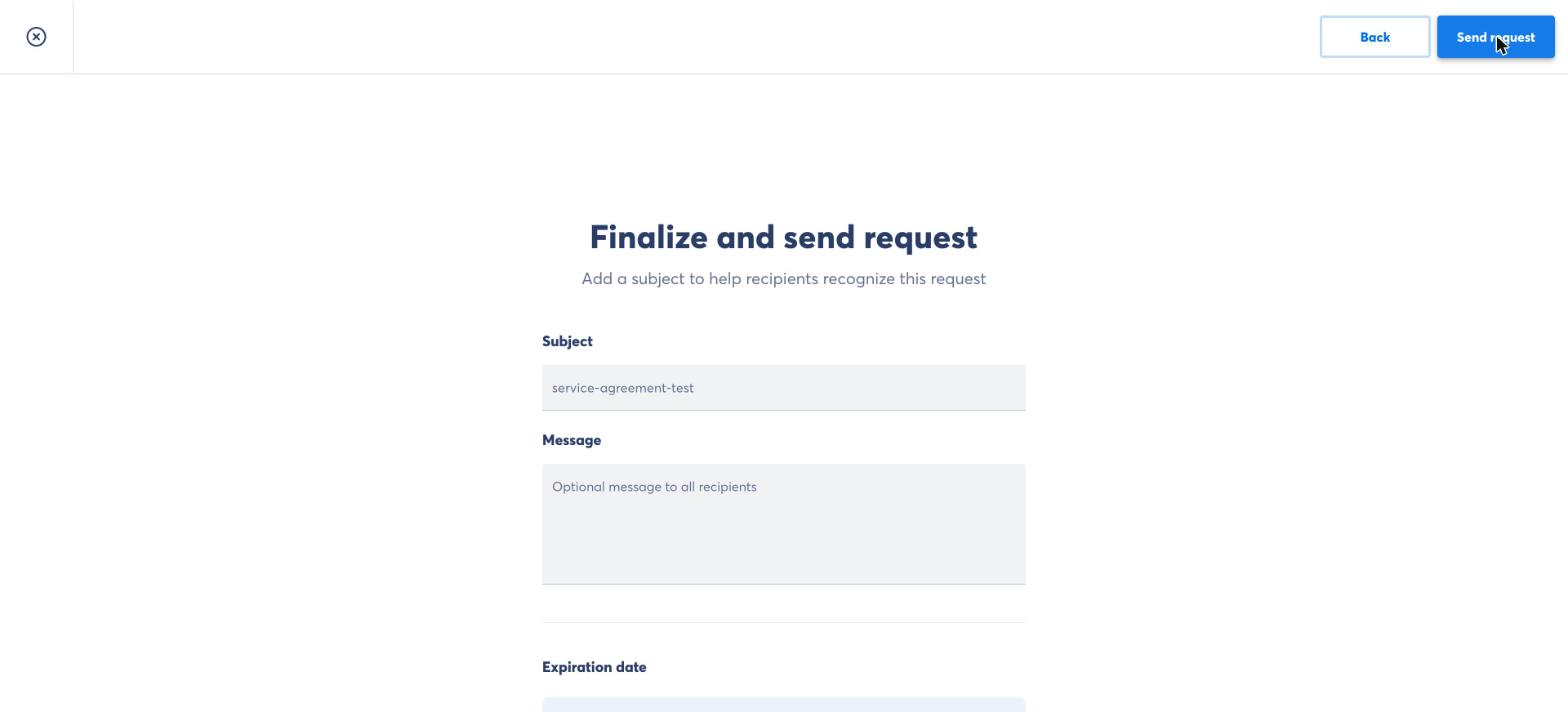
The final screen adds a subject, an optional message, an expiration date, observers and attachments. The subject is prefilled with the file name, so recipients see "service-agreement-test" unless you change it. The request view showed a deletion date 30 days after sending on the account we used; Skribble's FAQ says admins on Pro can define deletion periods.
The Signer's Side
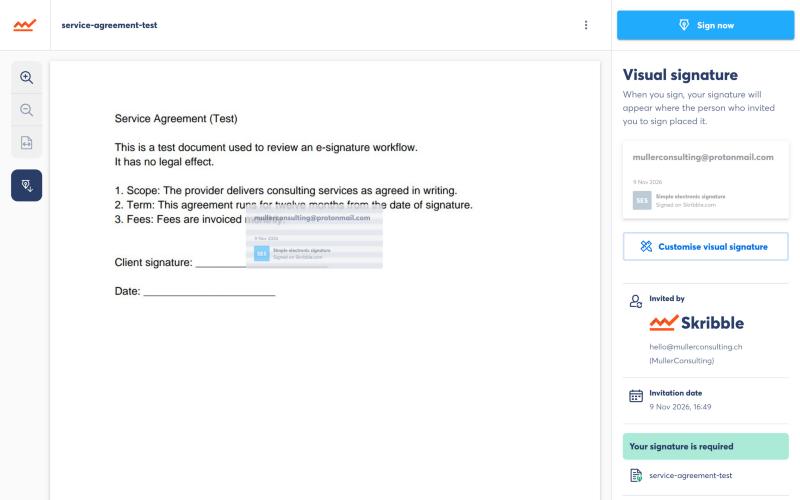
The invitation arrived within about a minute with a "Review and sign" button, and the recipient could sign without a Skribble account. The signing page shows the document, the stamp that will appear and who sent it. After we withdrew the request, its status changed to "Cancelled", while the signer's row in the sender's view still read "Pending".
How the Skribble Signing Experience Compares
Sign.Plus focuses on providing several signing workflows at one published subscription price:
- Preparing the document. Sign.Plus Auto-Place places fields automatically on uploaded documents for the sender to review and assign.
- Choosing recipient verification. A sender can assign a different check to each recipient, including an included passcode, an SMS code or an ID Check with a government ID. ID Check costs $2 per check.
- Signing in person and with public forms. Both are included on Sign.Plus Professional at $19.99 per user per month on annual billing. They are not listed in Skribble's plan comparison.
- Reaching signers by phone. Sign.Plus requests can be delivered by SMS or WhatsApp, with an allowance included in every paid seat. These delivery channels are not listed in Skribble's plan comparison.
- Using reusable templates. Sign.Plus Professional includes 10 templates. Skribble's FAQ says reusable web templates with fixed field positions are not yet available.
7. Skribble API and Developer Access
Skribble lists API access on Pro, which costs €36 or CHF 36 per user per month on annual billing or €49 or CHF 49 monthly. The company publishes an electronic-signature API page but does not publish a separate API price list. Teams needing API access should confirm volume limits, implementation terms and any additional charges with Skribble.
Skribble offers SharePoint and OneDrive integration through Microsoft Marketplace and Google Drive integration through Google Workspace Marketplace. Pro also lists signing from Word and Excel. Salesforce is listed on Scale.
How Skribble's API Compares
| Plan level | Skribble API | Sign.Plus API, annual billing |
|---|---|---|
| Testing | Public API pricing not published | Sandbox for testing |
| Entry | Pro subscription required; €36 or CHF 36 per user per month annually | Essential: $75.99 per month, 50 requests |
| Higher volume | Terms and price not separately published | Grow: $279.99 per month, 200 requests; Scale: $659.99 per month, 600 requests |
| AES and QES | Available through Skribble workflows; confirm API pricing | Supported on every API plan; QES credits cost extra |
What this means for you. Skribble includes API access inside Pro, but does not publish a separate API rate card. Sign.Plus publishes the monthly allowance and price for each API plan, and every API plan supports SES, AES and QES. See Sign.Plus API plans.
Single Sign-On (SSO)
Skribble publishes SSO as an optional Pro add-on. OIDC costs €2,000 or CHF 2,000 once for setup plus €2,490 or CHF 2,490 per year. SAML 2 and OAuth are available on request. These fees sit on top of the Pro subscription.
Sign.Plus includes SSO on Enterprise at $49.99 per user per month on annual billing. Company branding is included on Sign.Plus Business at $29.99 per user per month annually. Skribble charges €1,400 or CHF 1,400 per year for company branding on Pro.
8. Check Recent Skribble Reviews
Pricing pages and terms explain what a provider promises. Recent users can show how the product works in practice. We do not summarize changing review scores here. Instead, search for current experiences and look for patterns across several sources.
- "Skribble QES identification" with your country, to see which identification route recent signers used.
- "Skribble pricing" and "Skribble Starter", to check how the pay-per-signature plan is presented after the current source conflict.
- "Skribble API pricing", if developers need costs beyond the Pro subscription.
- "Skribble data center change", if your organization may need to move documents between Switzerland and Germany later.
- "Is Skribble safe?", followed by the certification or compliance framework your procurement team requires.
Sort independent review sites and community forums by the most recent date. Treat individual complaints as personal experiences and look for recurring themes rather than drawing a conclusion from one review.
Should You Switch?
Skribble remains a reasonable choice for DACH-focused teams that need SES, AES and QES, want Swiss or German storage and can use its pooled signature model. Switching becomes more attractive when you want a lower published base team subscription, reusable templates with fixed fields, in-person signing, public forms, phone delivery or a wider storage-location choice at published plan prices.
Sign.Plus is the stronger overall choice for teams that want unlimited signature requests and common signing workflows on Professional, with QES available on every plan, published API tiers and Enterprise options for SSO, 43 storage locations and HIPAA support with Advanced Security Controls and a signed BAA.
Contract Terms to Read Before You Sign
Skribble's published terms contain several points to understand before subscribing:
- Automatic renewal. Monthly and annual subscriptions renew automatically unless canceled before the next billing date.
- Plan downgrades. A downgrade takes effect only at the end of the term and requires 30 days' notice.
- Seat reductions. Seats can be reduced only at the end of the term. The terms do not attach the same explicit 30-day notice to seat reductions.
- Upgrades. An upgrade starts a new plan term immediately. The prior plan is credited pro rata, but unused signatures from the prior plan expire at the upgrade.
- Data location. The Swiss or German data center selected at setup stays fixed for the entire customer contract, so a renewal is not a chance to switch.
- Governing law. Swiss law and Zurich courts apply to Skribble Switzerland customers, while German law and Karlsruhe courts apply to Skribble Germany customers.
Canceling Skribble: What to Know
Check the renewal date and submit the cancellation before the next billing date. If you intend to downgrade, allow at least 30 days before the end of the term. If you only want to reduce seats, the reduction can take effect at the end of the term.
Before changing the account, download the signed documents and signature protocols you need to retain. Also record the selected data center, integrations, QES identification workflows and any SSO or branding add-ons tied to the account.
How to Switch From Skribble
- Check the term and renewal date. Allow for Skribble's 30-day notice requirement if you plan to downgrade.
- Export signed documents and evidence. Download the files and signature protocols required by your retention policy.
- List every signature standard you use. Separate everyday SES workflows from AES and QES cases so you can compare costs accurately.
- Map integrations and identity routes. Document API, Microsoft, Google, Salesforce, SSO and QES identification dependencies.
- Rebuild recurring documents. Create your most frequently used templates and forms in the new platform first.
- Run an end-to-end test. Test one agreement on a computer and phone, including the required identity check and completion evidence.
- Cancel before renewal. Keep both systems available long enough to finish requests already in progress.
Best Skribble E-Signature Alternatives
Skribble Alternatives at a Glance
| Platform | Team plan, annual billing | Sending limit | Best for |
|---|---|---|---|
| Sign.Plus | $19.99 | Unlimited | In-person signing and forms on Professional, QES on every plan and flexible Swiss-led storage |
| Skribble | €23 or CHF 23 | Unlimited SES; pooled AES/QES allowance | DACH teams using several European signature standards |
| DocuSign | $25 | 100 envelopes per user per year | Low-volume standard signing |
| PandaDoc | $19 | Unlimited in the app | Proposals and quotes |
| Dropbox Sign | $25, 2-user minimum | Unlimited on paid plans | Teams whose files live in Dropbox |
| SignNow | $8 per account | 100 invites per account per year | A few simple agreements each year |
| Adobe Acrobat Sign | $23.99 for Acrobat Pro for teams, billed monthly | No caps in Acrobat; 150 per user per year on Sign Solutions | Teams that edit PDFs in Acrobat |
| Zoho Sign | $16 for Professional | Unlimited from Professional | Teams already using Zoho CRM or Zoho One |
| DeepSign | CHF 19 per month for up to 10 users (Small), plus per signature | Pay per signature: SES CHF 0.50, AES CHF 1.00, QES CHF 1.80 | Swiss teams with low, irregular signing volume |
Sign.Plus: Best Overall Skribble Alternative
Sign.Plus is our pick for teams that send contracts every week and want common signing workflows at published prices. Professional includes unlimited signature requests, up to five users, 10 templates, in-person signing, public forms and attachment requests for $19.99 per user per month on annual billing. Passcode verification is included, SMS code verification is available and ID Check costs $2 per check.
Every Sign.Plus plan, including Free, supports QES at $5 per recipient, with identity verification included in that price. Purchased QES credits do not expire. Enterprise adds SSO, HIPAA support with the required controls and BAA, and 43 storage-location choices. Sign.Plus is built by Alohi in Geneva, Switzerland, is certified to ISO/IEC 27001:2022 and has a SOC 2 Type 2 report. Compare Sign.Plus plans and start a free trial.
Best for: teams that need unlimited signing, reusable templates, in-person signing, public forms, optional recipient verification, qualified signatures and flexible storage choices from a Swiss provider.
DocuSign: Standard Signing With an Annual Envelope Allowance
DocuSign Standard costs $25 per user per month on annual billing and includes 100 envelopes per user per year. Qualified signatures, data residency, SSO and HIPAA support are listed on Enhanced, which is priced by sales. See our DocuSign review for the full breakdown.
Best for: teams that send a modest number of standard agreements and stay under the annual envelope allowance.
PandaDoc: Proposals and Quotes
PandaDoc Starter costs $19 per seat per month on annual billing, with unlimited uploads and e-signatures. Business costs $49 and adds CRM integrations, approval workflows and branding. Documents created through the API, forms or bulk send use paid usage credits. See our PandaDoc review for the full breakdown.
Best for: sales teams that build proposals and quotes every week.
Dropbox Sign: Signing Alongside Dropbox Files
Dropbox Sign costs $15 per month on Essentials for one user and $25 per user per month on Standard, with a two-user minimum, on annual billing. Paid plans include unlimited signature requests. SSO and data residency sit on Premium, priced by custom quote. See our Dropbox Sign review for the full breakdown.
Best for: teams whose files already live in Dropbox.
SignNow: Low Per-Account Subscription
SignNow prices its plans per account with unlimited users. Starter costs $8 per month and Business costs $30 per month on annual billing. Every self-serve annual plan shares 100 signature invites per account per year, and declined or canceled invites still count. See our SignNow review for the full breakdown.
Best for: small teams that send only a few simple agreements each year.
Adobe Acrobat Sign: Signing Inside a PDF Editor
Adobe builds e-signing into Acrobat Standard, Pro and Studio, from $14.99 per month for individuals and $23.99 per license per month for Acrobat Pro for teams on annual billing. Acrobat Sign Solutions is priced by quote and includes 150 transactions per user per year unless the contract states otherwise. See our Adobe Acrobat Sign review for the full breakdown.
Best for: teams that edit PDFs in Acrobat every day.
Zoho Sign: Signing Within the Zoho Ecosystem
Zoho Sign Standard costs $10 per user per month on annual billing, while Professional costs $16 and includes unlimited envelopes. In-person signing, bulk send, SignForms and API access are listed on Enterprise, and several actions use prepaid Zoho Sign credits. See our Zoho Sign review for the full breakdown.
Best for: teams already working in Zoho CRM, Zoho Books or Zoho One.
DeepSign: Pay Per Signature From a Swiss Provider
DeepSign, from DeepCloud AG, prices its plans by account size, from free for up to three users to CHF 19 per month for up to 10 users and CHF 199 for up to 100, excluding VAT. Every signature is billed on top: CHF 0.50 per SES, CHF 1.00 per AES and CHF 1.80 per QES, with lower rates in prepaid volume packages. Co-signers verify their identity for QES through its own DeepID app at no charge. Because no plan includes unlimited sending, the cost rises with every agreement, while Sign.Plus Professional includes unlimited signature requests for $19.99 per user per month on annual billing.
Best for: Swiss teams that sign rarely and want to pay only for the signatures they use.
Final Verdict
Skribble is a capable option for DACH teams that want SES, AES and QES, external signing without an account and a choice between Swiss and German storage. Its annual Team and Pro plans suit organizations that use up their pooled AES and QES allowances within the year.
Sign.Plus is our winner overall. Professional has a lower published base subscription price at $19.99 per user per month on annual billing and includes unlimited signature requests, reusable templates, in-person signing, public forms and passcode verification. SMS codes and ID Check are available at separate published prices. QES is available on every plan for $5 per recipient, including identity verification, and purchased credits do not expire.
For organizations that need more control, Sign.Plus publishes the price of Business branding, Enterprise SSO, HIPAA support (Enterprise with Advanced Security Controls and a signed BAA) and each API tier. Enterprise customers can choose among 43 storage locations and move documents later. Start a Sign.Plus free trial and test it with your own documents and signing requirements.
FAQs
How much does Skribble cost?

On annual billing, Skribble Team costs €23 or CHF 23 per user per month and Pro costs €36 or CHF 36, excluding VAT. Monthly billing costs €29 or CHF 29 for Team and €49 or CHF 49 for Pro. Starter has no subscription fee and charges per signature, and Scale is priced by quote. A one-time QES identification fee of €22.50 or CHF 22.50 can apply on top. Sign.Plus Professional costs $19.99 per user per month on annual billing with unlimited signature requests.
Is Skribble free?
Not as a free plan with included signatures. Starter lists a €0 or CHF 0 base price but charges €1 or CHF 1 per SES, €3 or CHF 3 per AES and €5 or CHF 5 per QES. Team and Pro offer a 14-day trial without a credit card. Sign.Plus has a Free plan with 3 signature requests in total, and QES is available on every plan at $5 per recipient.
Is Skribble safe?
Skribble states that its system architecture is ISO 27001 certified, that it uses AES-256 encryption and that it hosts data in Switzerland or Germany. SOC 2 and HIPAA support are not published in its public materials. Sign.Plus is certified to ISO/IEC 27001:2022, has a SOC 2 Type 2 report and supports HIPAA on Enterprise with Advanced Security Controls and a signed BAA.
What is Skribble AG?
Skribble AG is the Zurich-based company behind the Skribble e-signature platform, with Skribble Deutschland GmbH in Karlsruhe. It focuses on Switzerland, Germany and the wider DACH market and offers its platform in English, German, French and Italian.
Does Skribble support QES?
Yes. Skribble supports QES under Swiss ZertES and EU eIDAS. Signers usually complete a one-time identification first, which costs €22.50 or CHF 22.50 and stays valid for up to five years. Sign.Plus supports QES under eIDAS and ZertES through Swisscom Trust Services on every plan, including Free, at $5 per recipient.
Can I change Skribble's data center later?
No. Skribble's terms say the Swiss or German data center chosen at setup stays fixed for the entire customer contract, with no refund, credit or migration for a wrong choice. Sign.Plus stores documents in Switzerland by default, offers 43 locations on Enterprise and lets documents move later.

Artigos em destaque



Confédération Suisse
Confederazione Svizzera
Confederaziun Svizra
Confederação Suíça
Innosuisse - Agência Suíça de Inovação


