Electronic Lease Signing: How to Sign a Lease Online the Right Way
Signing a lease online saves the landlord a printer and the tenant a trip, but it raises fair questions: does it hold up, and what can't go electronic? This guide covers the US rules, the notices that need extra care, and a step-by-step workflow for landlords, property managers, and tenants.


- Under ESIGN and state e-signature laws, a lease can't be denied legal effect just because it was signed electronically.
- Eviction and default notices for a primary residence fall outside ESIGN, so check state law before sending them electronically.
- Use a template, verify each signer, and keep the audit trail.
Can you sign a lease electronically?
Yes. In the US, the federal ESIGN Act says a contract or signature can't be refused legal effect, validity, or enforceability only because it's in electronic form. A lease is a contract, so under ESIGN and state e-signature laws, a residential or commercial lease signed online is generally as enforceable as one signed in ink, as long as the usual rules for a valid lease are met.
State law adds a second layer. Each state has its own electronic signature law, many of them based on the Uniform Electronic Transactions Act (UETA), a model law states adopt as their own. Under UETA, when a law says a record must be in writing or signed, an electronic record and an electronic signature satisfy it. For the details by statute, see our overview of electronic signature laws in the United States.
What makes an electronically signed lease hold up?
Four elements are commonly cited under ESIGN and UETA. Get these right and the electronic part of the lease is rarely the weak point.
- Intent to sign. Each tenant and the landlord take a clear action to sign, such as clicking a signature field and confirming it.
- Agreement to do business electronically. Everyone agrees to use electronic records. This can come from the context and how the parties act, but writing it into the lease or the signing request removes any doubt.
- A link between the signature and the lease. The signature is attached to that exact document, not to a separate page someone could swap.
- A copy everyone can keep. ESIGN lets a record that must be in writing be denied effect if the people entitled to keep it can't store it and reproduce it accurately later. Send every signer a final copy.
One more rule surprises some landlords: ESIGN doesn't require anyone to agree to electronic signatures. If a tenant asks to sign on paper, offer a paper copy.
Which rental documents still need paper or extra steps?
The lease itself is rarely the problem. Some notices that come later are. ESIGN's rule doesn't apply to notices of default, acceleration, repossession, foreclosure, or eviction, or of the right to cure, under a rental agreement for someone's primary residence. Court documents and notices that utilities such as water, heat, or power will be shut off are excluded too.
That doesn't automatically make an emailed notice invalid, but it means the federal law won't back it up. Send those notices the way your state's landlord-tenant law requires, which is often personal delivery, posting, or mail, and don’t rely on email or an e-signature unless your state allows it.
Two other cases need care:
- Required written disclosures. When a law requires you to give a residential tenant certain information in writing, ESIGN only lets you deliver it electronically after the person consents. Before consenting, they must be told about their right to a paper copy, how to withdraw consent, and what hardware and software they need to open the records.
- Lead-based paint disclosures. For housing built before 1978, federal rules require the lease to include a lead warning statement and disclosure, signed and dated by the landlord, any agent, and the tenant. The landlord and agent must keep a copy for at least three years from the start of the lease. Before the tenant is bound by the lease, they must also receive the EPA pamphlet “Protect Your Family From Lead in Your Home” and any lead reports you have. Put the disclosure, the pamphlet, and any reports in the same signing request as the lease, so the tenant gets them before signing and everything is stored together.
States also add their own rules for some leases and notices, covering things like how notices can be delivered, translation into the tenant's language, or how consent must be given. If you rent in more than one state, check each one. This guide explains general US rules and is not legal advice; for a specific lease or notice, ask a local attorney.
How do you sign a lease electronically, step by step?
Here is the landlord's side of the process, from blank lease to signed copies in everyone's inbox.
- Prepare the lease. Start from your own lease or a residential lease agreement template, and attach any addenda: pet rules, parking, the lead-based paint disclosure if the building is older than 1978.
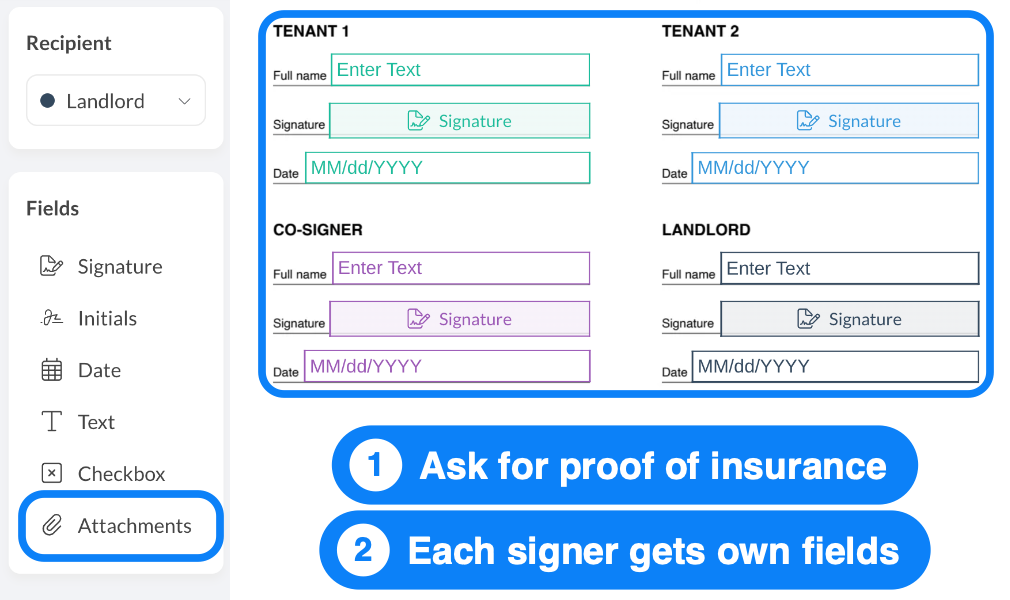
- Add every signer. List each adult tenant named on the lease, any co-signer or guarantor, and yourself or your agent. Give each person their own email address, never a shared one, so each signature traces back to one person.
- Place the fields. Add signature, initials, date, and text fields where each person needs to act. Initials next to the rent amount, deposit, and house rules are a common choice.
- Set the signing order. Tenants and co-signers usually sign first, and the landlord countersigns last. If order doesn't matter, everyone can sign at the same time.
- Choose how signers prove who they are. An email link is the baseline. For tenants you've never met in person, add a passcode, a code sent by text message, or a government ID check.
- Send and track. Add a short message, set reminders and a deadline, and watch the status change as each person opens, views, and signs.
- Countersign and share copies. Once you sign, send the completed lease to every party and keep the signing evidence with your copy.

What does the tenant have to do?
Very little, which is the point. The tenant opens the link in their email, reads the lease, and fills in the fields marked for them. They can sign on a laptop or a phone, and in most tools they don't need to create an account.
Encourage tenants to read before they sign, just as they would on paper. If something is wrong, such as the rent amount or the move-in date, they should decline and tell you rather than sign and sort it out later. After the last signature, each tenant should receive a copy of the completed lease to download and keep.
How do property managers handle lease signing at scale?
One lease a year is easy by email. Forty units with staggered renewals is a different job. Property managers who run lease signing online tend to set up a few habits early:
- One template per lease type. Build a template for each property or state with the fields and signing order already in place, so a new lease takes minutes. Our templates keep roles, reminders, and expiry settings for every send.
- Renewals in one batch. When many leases renew in the same month, bulk sending lets you send one renewal template to a whole list of tenants at once, uploaded as a CSV file.
- Walk-ins at the leasing office. When a new tenant is in the office, in-person signing lets them sign on your tablet or computer without waiting for an email.
- Collect documents with the signature. Ask tenants to upload files as part of signing, such as proof of renters insurance, instead of chasing them by email afterward.
- A folder per property. Store signed leases in folders by building or unit, so each lease is easy to find at renewal time.

Remote applicants are where identity matters most. A rental listing can attract people who sign with a borrowed name. Checking the signer's ID before they can open the lease costs a minute and gives you something concrete if the tenancy goes wrong.

How does Sign.Plus handle electronic lease signing?
When you choose a tool for leases, look past the signature itself. The useful questions are how it checks who signed, what evidence it keeps, and how easy it is for a tenant who has never used it. Here is how Sign.Plus answers them.
- Verification chosen per signer. With recipient verification, you pick a passcode, a text message code, or ID Check for each person on the lease, so a remote tenant can get an ID check while a co-signer you know uses a passcode. The lease stays hidden, preview included, until the signer passes the check. With ID Check, you see a confirmation and the name from the ID, the ID images stay private, and the request can't be passed on to someone else.
- Nothing to install for tenants. Tenants sign from the email link without creating an account, on the web or with the iOS and Android apps.
- Evidence that stays with the lease. Every lease gets an audit trail that records who opened and signed it, when, from which IP address and device, and which verification step they passed. The Certificate of Completion collects that evidence in one downloadable file, kept separate from the lease by default to protect tenants' personal data. Completed documents stay available while you use them, and the audit trail and certificate are kept indefinitely.
Leasing is only part of a property business. Sign.Plus for real estate covers the rest of the paperwork, from management agreements to subleases.
Electronic lease signing checklist
Run through this before you send your next lease:
- Every adult tenant, co-signer, and guarantor is listed as a separate signer with their own email.
- Required addenda are attached, including the lead-based paint disclosure for pre-1978 housing.
- Signing order is set, with the landlord or agent signing last.
- Identity checks match how well you know each signer.
- Reminders and a deadline are on.
- Tenants know they can ask for a paper copy.
- Every party receives the completed lease.
- The audit trail or completion certificate is saved with your copy.
- Eviction, default, and similar notices go out the way your state requires, not by default e-signature.

Ready to send one? Set up your first lease template and add recipient verification for tenants you haven't met.
FAQs
Is an electronically signed lease legally binding?

Yes, in most cases. ESIGN and state e-signature laws say a lease can’t be denied legal effect only because it was signed electronically. The lease still has to meet the normal rules for a valid lease in your state. Our guide to US electronic signature laws explains the framework.
Can a landlord require a tenant to sign a lease electronically?
ESIGN doesn't require anyone to agree to electronic records or signatures, so a tenant who wants paper should be offered a paper lease. The US e-signature law overview covers consent in more detail.
Can I send an eviction notice electronically?
Be careful. ESIGN does not cover notices of eviction, default, or the right to cure under a rental agreement for a primary residence, so federal law won't back up an electronic notice. Follow your state's delivery rules, which often require personal delivery, posting, or mail. Leases and renewals themselves can be signed online with a template.
Do roommates and co-signers each need to sign?
Each person named on the lease should sign it, and each should have their own email address so the signature traces back to them. Set a signing order so the landlord countersigns after everyone else. A residential lease agreement template gives you a starting point with the parties laid out.
Can I renew a lease electronically?
Yes. A renewal or extension is signed the same way as the original lease. Saving your renewal as a template keeps fields, signers, and reminders ready for the next round, and bulk sending handles many units at once.
How do I prove who signed an electronic lease?
Keep the signing evidence: the audit trail with timestamps, IP addresses, and verification steps, plus the completion certificate. Adding a passcode, text code, or ID check before signing makes that evidence stronger. Our guide on how to verify an electronic signature walks through each check.

Related guides




Confédération Suisse
Confederazione Svizzera
Confederaziun Svizra
Swiss Confederation
Innosuisse - Swiss Innovation Agency